

This is quite a lengthy post and I apologize in advance. But if you’re only interested in certain sections, I’ve clearly labeled them and you can scroll to what you’re interested in. To give you a short overview I discuss why I believe agent guides are a response to the publishing industry evolving. Then I dive into my own post where I go through each of the 4 images I posted, where I also discuss hooks and how to identify/use them as well as things I would do differently. To conclude, I provide suggestions of fun/unique ways in which you can be creative and with your agent guide.
What prompted the Existence of Agent Guides?
Besides them just being fun to make!
We are constantly evolving as a global society, and adaptation is the key to survival and success. I feel like this argument is sometimes used to justify the implementation of AI in writing (I don’t agree), but it is applicable to Agent Guide posts on social media.
There is significantly more competition when it comes to getting an agent than there was ten years ago. And here is why I think that is:
The initial barriers of entry are lower than before: I don’t consider the first barrier of entry to be getting an agent. Rather I believe it has to do with available resources that help you prepare a query package in the first place. There are now so many more craft books, so many tips on how to write a query, so many more successful queries that are posted online from which we can learn and use to make our own queries better. This is, overall, beneficial to all aspiring authors. Which leads me into the second point…
The volume of queries is higher than before: This is, in my opinion, a direct consequence of the first point, which also bleeds into the third point, but I will get to that later. Everyone has a computer and everyone can claim they can write a book. The research process no longer filters people out as it once had, and we can see that from the sheer volume of submission that agents receive.
The general quality of submissions is higher: due to this influx of information, people can more often and more consistently produce high quality query packages. This allows agents to be significantly more choosy within this enormous volume of submissions. And I gather, psychologically, that they must be choosy as when you read thousands of queries, patterns start emerging very quickly, and truly unique concepts will stand out significantly more.
The difficulty in getting noticed in the slush pile may sound bleak, but for every obstacle faced, something always appears to help overcome the obstacle, and in my opinion, that’s the agent guide.
The dreaded algorithm makes it tricky and a game of chance, however I think it’s worth it to gamble because you have nothing to lose and everything to gain. And here is what I think you have to gain:
Fresh mindset: posts from writers pop up on agent timelines all the time. If they stumble on your agent guide while scrolling social media, and not while they’ve read 50 queries before reaching yours, they view it with completely different eyes. Just as writers sometimes need a different location, a different font, a different playlist to get out of a writing funk, agents also see book concepts differently if they’re presented in another context.
Calling upon different senses: agent guides are inherently visual. If you have sick aesthetics or beautiful character art (spoiler I had none of these), these are all tools you can use to grab an agent’s attention. Even if you don’t (like I didn’t), presenting your concept in a different way can get you the attention you need. The idea here is that you never know, so trying (especially when it’s free) is never a bad idea!
Presenting in a pitchable way: as I’ve said in previous posts, an agent’s ultimate goal is to pitch your book to an editor. When they consider your query package, they’re already thinking about how they’d to it, to who they would pitch it to, etc. An agent guide allows you to extract everything unique, marketable, pitchable, and showcase it in an easy to digest manner. Essentially, you’re doing part of the work for the agent. They don’t need to extract this from your query—you’re already doing it for them.
And to piggy back off point 3, how do you extract what’s unique, marketable, pitchable? How did I do it?
My Agent Guide
I made a single post which I pinned to my profile. Is it the most aesthetic looking thing? No. Did I get a whole lot of likes? 81 is a lot for me, but it’s not some crazy number either. It only reached 332 people as you can see in the stats below (I took this screenshot a year ago). But I think it did what it needed to as I got one agent DM and another (my now agent) commented on it asking to be queried!
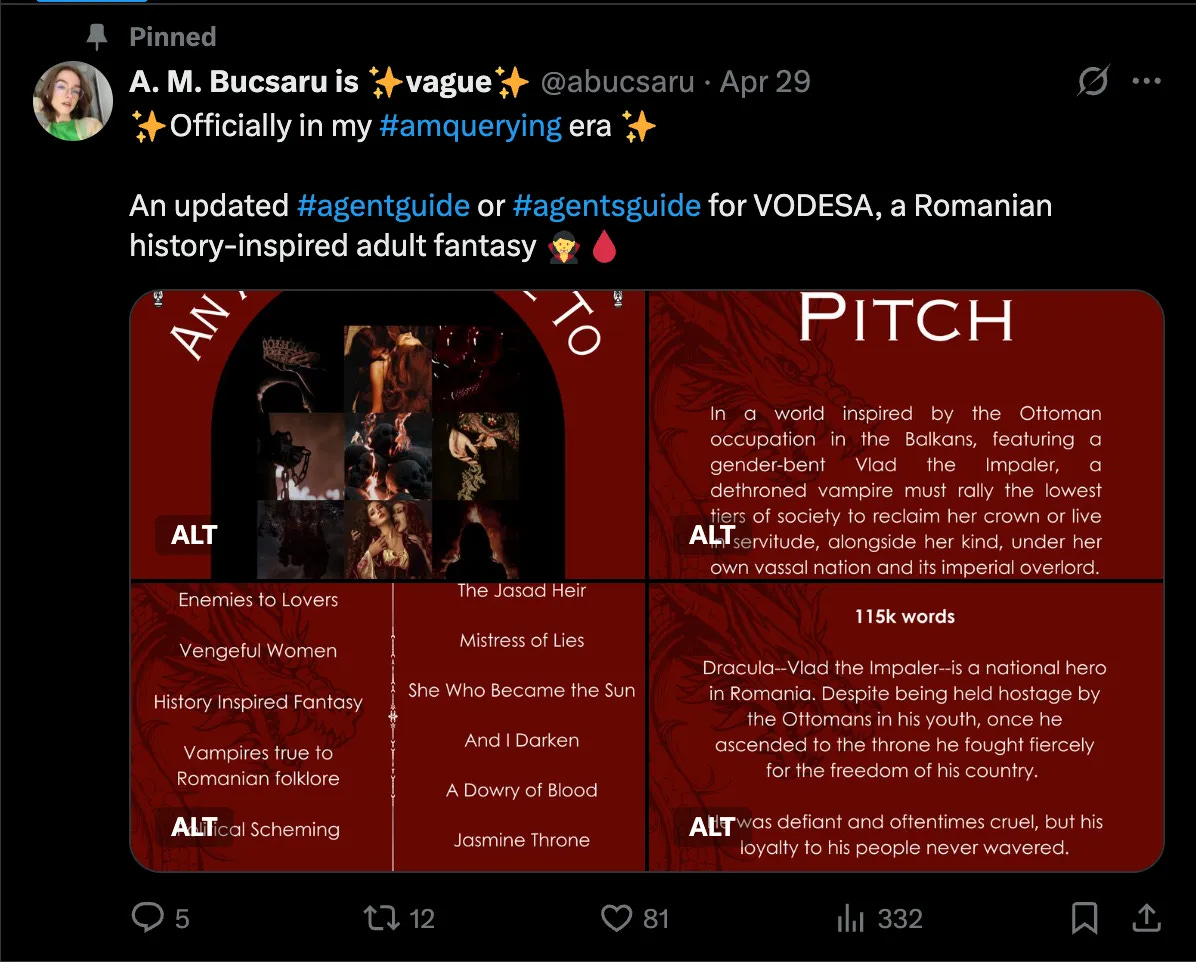
Again, I think I got lucky. I think it showed up on the timeline at an opportune moment, that the right people first gave it a like and a repost, that it reached agents at a time when they were willing to look at an agent guide, etc etc.
My point is that an agent guide is not a guarantee, but it IS a chance. And I’d like to break down what I did in my guide to hopefully help you with your odds. Please, don’t take what I say as gospel. This is all just my opinion and my personal experience. I don’t hold any ultimate truth about agent guides and I would personally use this post as inspiration and not a blueprint. Take what you like, ignore what you don’t.
Let’s break down each image and analyze what elements I believe drew the right kind of attention, and what I think could be improved upon aesthetically or otherwise.
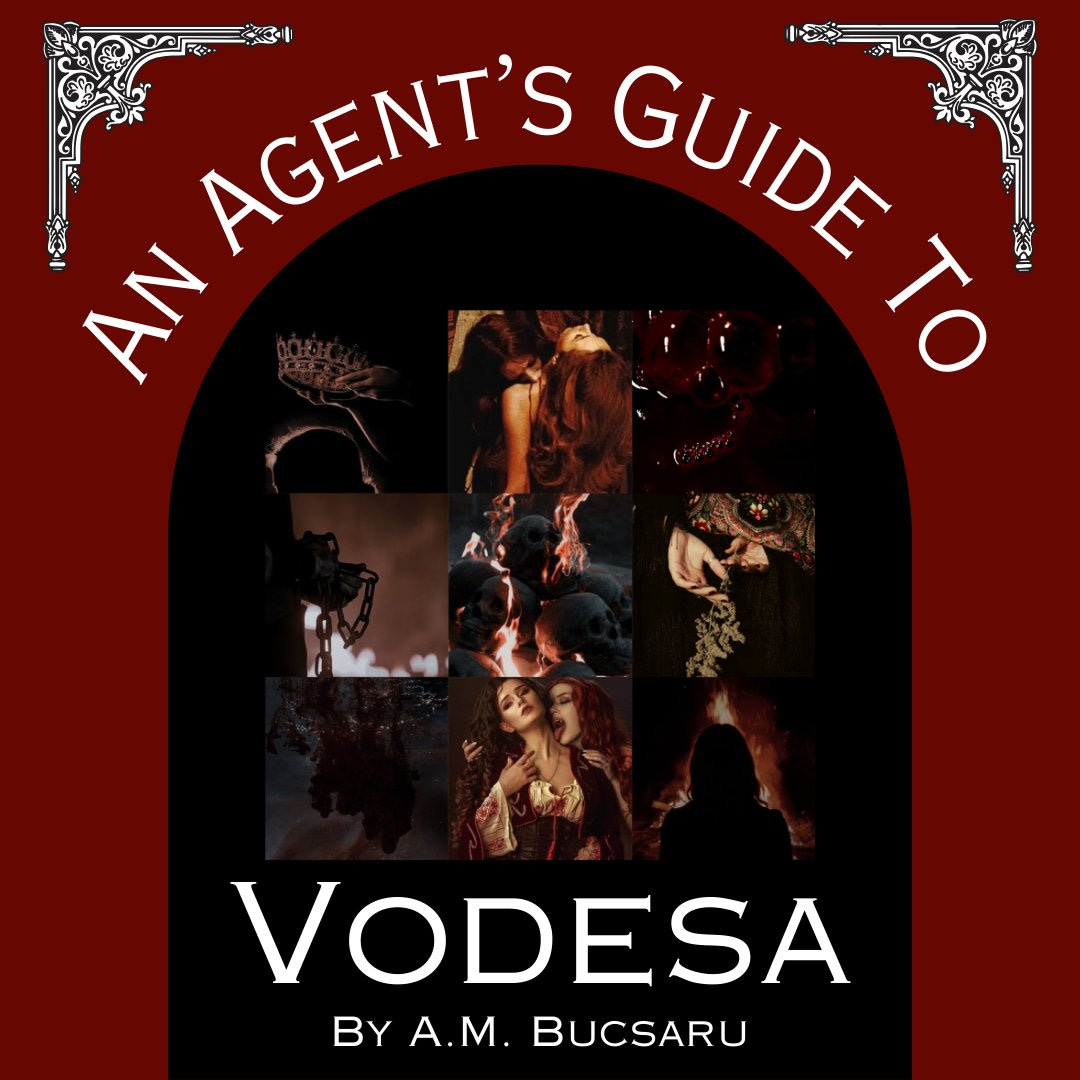
What I think I did right:
My book’s maiden name was Vodesa, and now her agent-married name is The Fanged Heir. In the first image I’ve included a moodboard so you can get the vibes of the story. It’s dark, with Romanian vampires, with lots of political intrigue, and most importantly, about oppression. I feel like the moodboard gives you a fairly decent idea of what you expect when diving into the story.
What I would improve:
If I could go back in time, I would change the dimensions of the image so you can see the entire content of the image without clicking on it first (as in I wouldn’t make the images square). It would’ve been better, I think, if a viewer could be able to read it at first glance. Also, it’s not the most aesthetically pleasing thing out there. The more I look at it, the less happy I am with its appearance to be completely honest with you guys.
And this is why I think the content of it “saved” me.
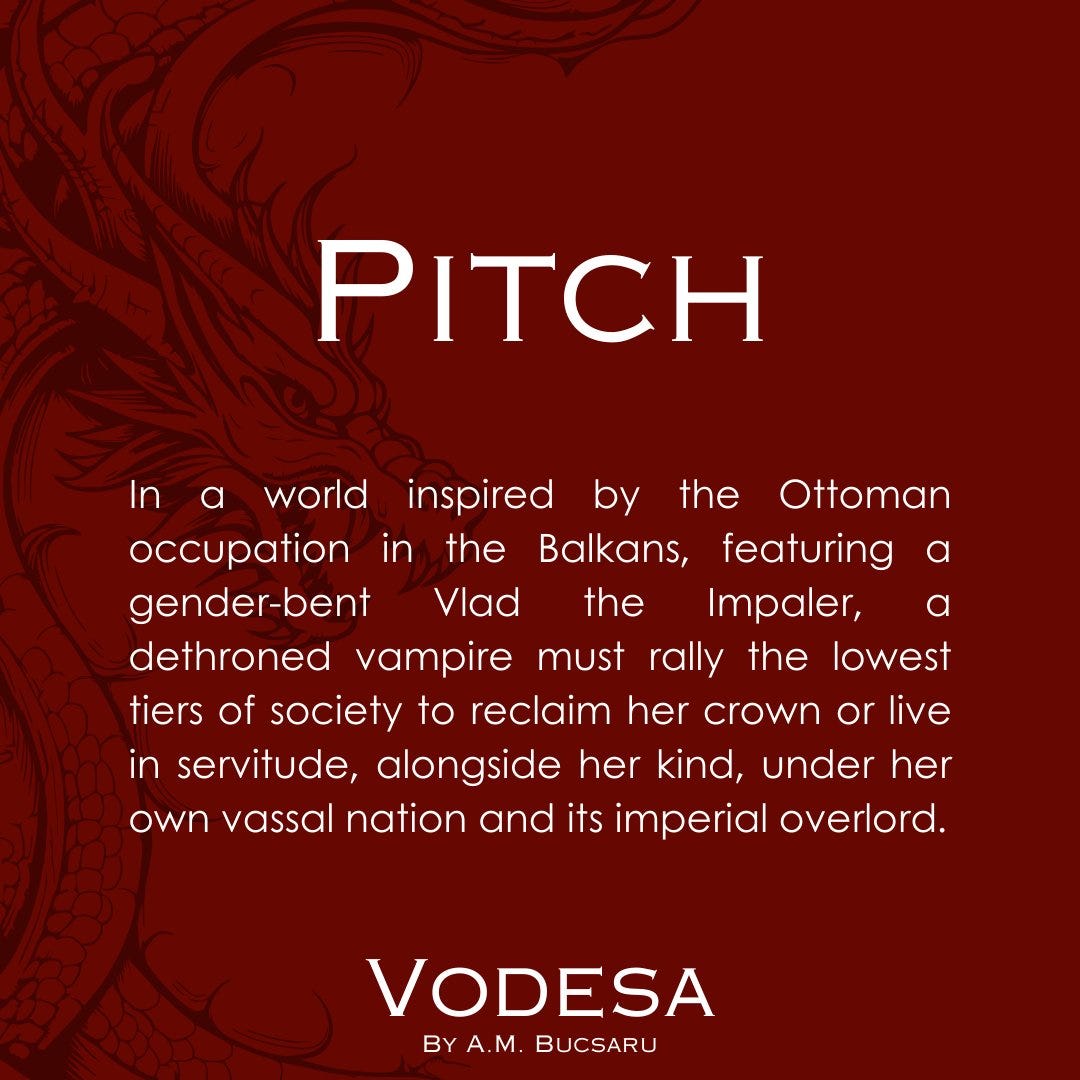
What grabbed my Agent’s Attention?
My second image after the “cover” was my pitch, and after talking to my agent, this was the “star” of the agent guide. It’s difficult—most high fantasy writers will agree with me on this one—to write a well-defined pitch. Apparently, mine showed that it could be a high-concept story and this is what had grabbed her attention and prompted a request for further materials. Is my pitch a lengthy sentence? Yes. But it covers all you need to know:
Who? a dethroned vampire
Goal? must rally the lowest tiers of society
Motivation? to reclaim her crown
Why that will be difficult? because she’s dethroned and lowest tier of society
Stakes? or live in servitude
And…
the pitch starts with my hook.
I initially wanted to discuss hooks in my query autopsy, but I’ll talk about it here too because there’s never too much information on hooks. Everyone talks about them. But how do you identify your hook?
Hooks
I would like to break it down to you the same way I break it down to myself. I see hooks as two distinct categories: meta hooks and blurb hooks.
Meta hooks: are tied to story inspirations (people, other works, historical events), world building, etc.
Examples:
My book: Inspired by 15th century Ottoman occupation in the Balkans, featuring a gender-bent vampiric Vlad the Impaler
Silvercloak: Set in a world where magic is fueled by pleasure and pain
Thoughts Be Bloody: A queer, trans Hamlet retelling set at a magical university
Blurb hooks: are tied directly to your plot.
Examples:
The Shadows Between Us: They've never found the body of the first and only boy who broke my heart. And they never will.
Funny Story: A woman is left by her fiancee for his childhood best friends and now homeless, she ends up living with the best friend’s ex boyfriend. (I came up with this myself right now so it’s not good but you get the idea).
Immortal Consequences: Six dead teens compete at a magical school in the afterlife
Take a look at your story and try to identify which category your hook falls into, and try test out amongst your friends or even random people different variations of hooks and see which one is more attention grabbing.
Then you start your one sentence pitch with your hook to make sure it’s the first thing an agent sees. I don’t think I’m the best at writing one sentence pitches, though I feel like I am getting better at it as I practice. Maybe when I feel confident, I’ll write about it in the future, but for now, here and here are some resources I used when writing my one sentence pitch.
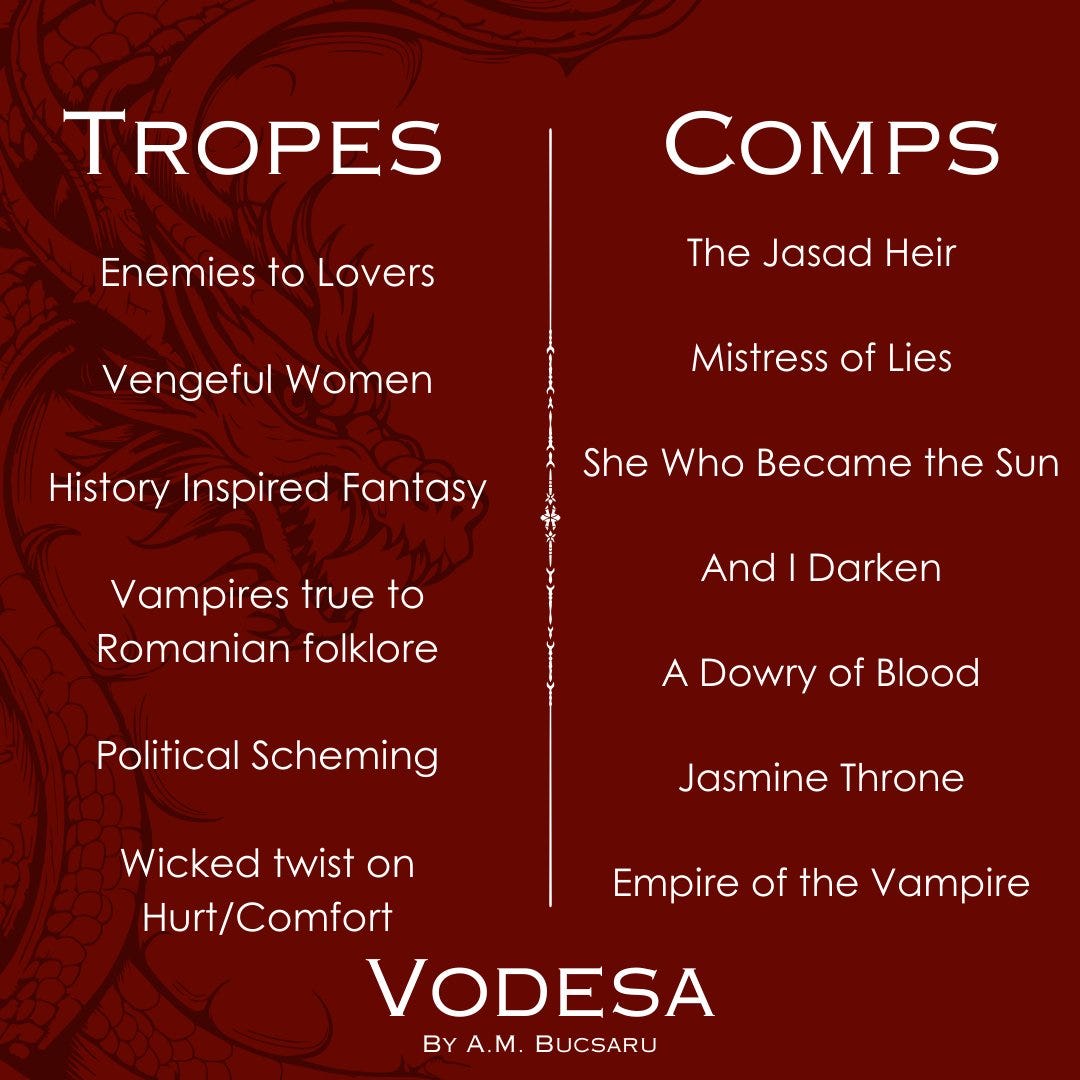
I added my tropes and comps to the third picture because I had something specific planned for my fourth and last. You can, however, put them on separate images and therefore conclude your agent guide. In some cases, I do believe that last page is better used for something else, but I’ll get into that later.
Tropes
My goal with the tropes was the following: what can I show that is known and loved, and what can I show to prove that I bring something different to the table? Because that’s the goal, in the end. The publishing industry wants to see something different, something new, but not so different that they can’t place it on the shelves. So a combination of classics and your own spin on things can show that, and I hate to say this, “you’re playing by the rules”.
Classic tropes: enemies-to-lovers, vengeful women, political scheming. These give you the big vibes of the story. You know there will at least be a romantic sub-plot. That through the vengeful women trope you can assume violence, morally grey characters, revenge arcs. You can guess through the political scheming trope (also using the pitch as context) that there will be a “game of thrones” situation going on.
My personal touch: History inspired fantasy (15th century Ottoman empire in the Balkans from the pitch) is a fairly unique setting. Vampires true to Romanian folklore is also pretty unique. I am also Romanian which I feel gives me a fair bit of authority on the subject. Through wicked twist on hurt/comfort I promise to bring my own spin on a classic trope.
So essentially, I try to ground the agent in familiar tropes and also introduce what makes my story unique despite these familiar tropes. People love the familiar. Tropes exist for a reason. But fresh perspectives are always welcome and I believe that a balance between the two is the sweet spot.
Now I don’t know whether publishing professionals think about queries or agent guides in such detail. I don’t know what the distribution of weight is when it comes to decision making. BUT I am fairly certain that they consider such things, at the very least, on an instinctive or subconscious level.
What I would retrospectively change
While I don’t regret my choice of tropes, I would change them now and at least add something about oppression. It’s integral to my story and I should’ve showcased it more in my agent guide. I feel like I was redundant with “History Inspired Fantasy” as it’s already been stated in the pitch. There’s not enough “space” to needlessly repeat myself and here I think I made a mistake. Instead, I’d swap it with “exploring tiers of oppression” or something similar to that. In any case, I’d swap it with something new that hasn’t been clearly spelled out anywhere else in the agent guide.
Comps
Because I didn’t add images or create a special page for the comps, I had plenty of room to simply list titles. So I got creative and disregarded the rules of comps for a query letter. Here, we were just going for vibes.
Essentially, the comps fit into 3 groups:
Setting & Worldbuilding: And I Darken, Empire of the Vampire, Dowry of Blood
General Plot Elements Similarities: She Who Became The Sun, The Jasmine Throne (so more focused on gaining power, political scheming, war & revolutions, etc, 3rd person multiple POVs)
MC Motivation & Drive: Mistress of Lies, The Jasad Heir
I have no idea if my comps made a difference or not, but I tried to make sure I at least had some recent comps, stayed away from listing too many huge titles, and due to the fairly large number of titles listed, I even added a YA (And I Darken) which is a historical fiction novel set in Romania feature a gender-bent Vlad the Impaler, showing that such concepts do sell.
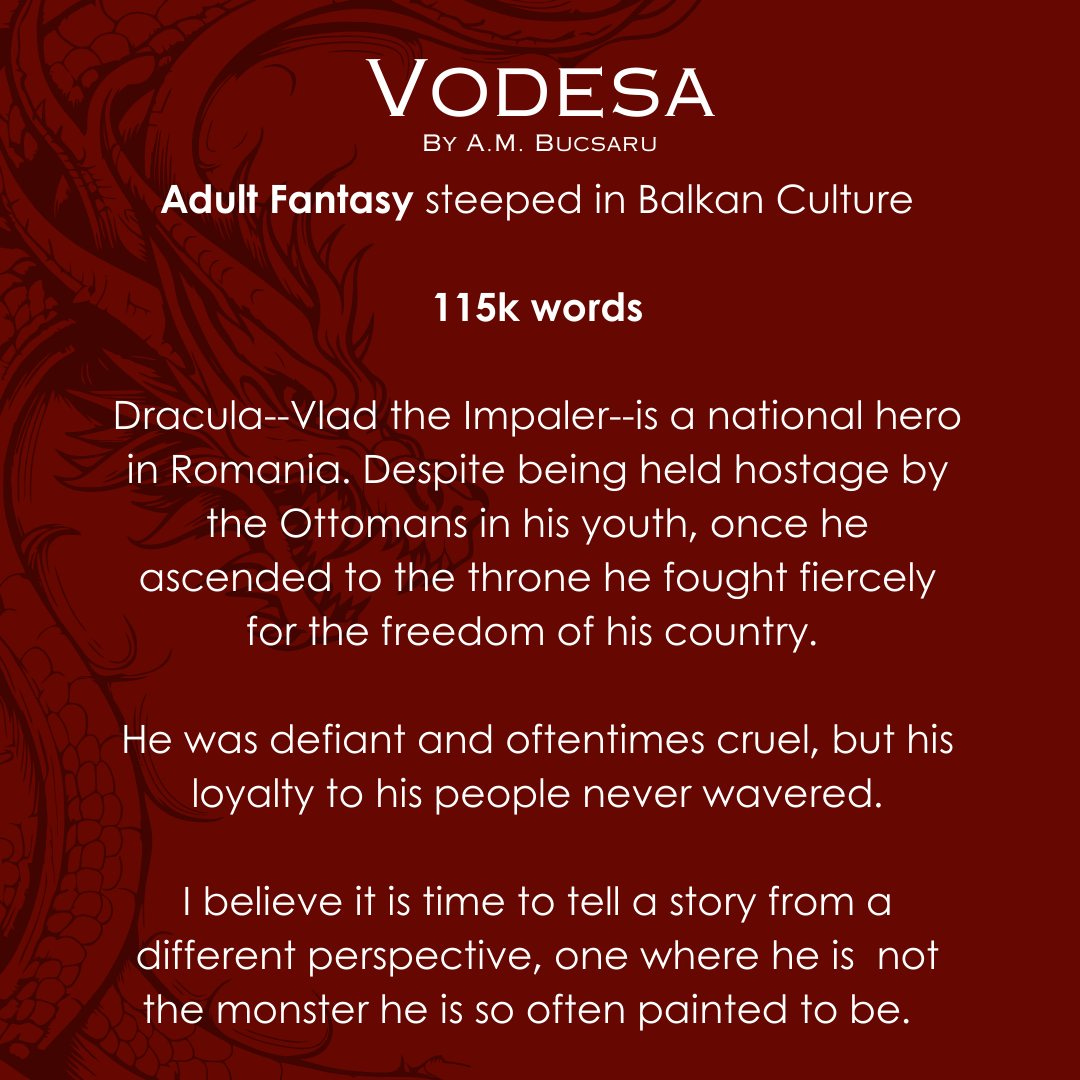
Here, in my last image, I took a bit of a risk. The reason why I wrote this book was very important to me, and therefore I wanted to talk about it. I wanted to give real-life context as to why I believe this story deserves to exist and why I believe this reason makes it interesting.
Hey, maybe I’m the only one that cares. Maybe this actually isn’t interesting at all, and it’s only important to me because it’s MY history. But I took a gamble. I don’t think it paid off, but it made me feel good, and it satisfied my soul to know that I put this out somewhere in the world and I got to tell “my story”.
Again, what I’m about to say is a gamble. Perhaps it’s a personal preference and only I would think it’s cool or interesting. So take everything I say with a grain of salt because I’m not an agent and I can only give my opinion and share my personal experience.
Alternate Ideas for Agent Guide Images
If I’d written a different kind of story, I would have formatted my agent guide in another way. Specifically, I would change what information I presented in the fourth image. For example:
If I wrote a retelling, I’d briefly describe how I bring a fresh perspective.
If I had a BANGER first line, I’d add a snippet of my opening.
If I was doing an Emily Henry style trope flip, I’d dedicate a page to that with the Hallmark trope and how I do it differently.
If I wrote Heated Rivalry, I’d do a hockey collage page. This applies to any sports romance ESPECIALLY if it’s inspired by real dynamics.
If I wrote Stormlight Archives, I’d showcase each Radiant order on the last page. This applies to any story that has a really cool and unique magic system that I want to show off. The cards in One Dark Window or how the silver translation bars work in Babel.
If I wrote Bridgerton, I’d dedicate the last image to Lady Whistledown. This applies to any story that contains a fictional piece of media that is central to the story (reality TV show setting, YouTube channel, if the story is driven by a prophecy, etc).
I’m sure there’s so many more cool ideas, but I hope that if my ideas aren’t helpful, they can at least inspire you to come up with something even better.
Thanks for sharing this! I have seen these popping up and have been on the fence about whether to create one.
hi fellow balkan person, IMMEDIATE subscribe!!! <3